
Origin
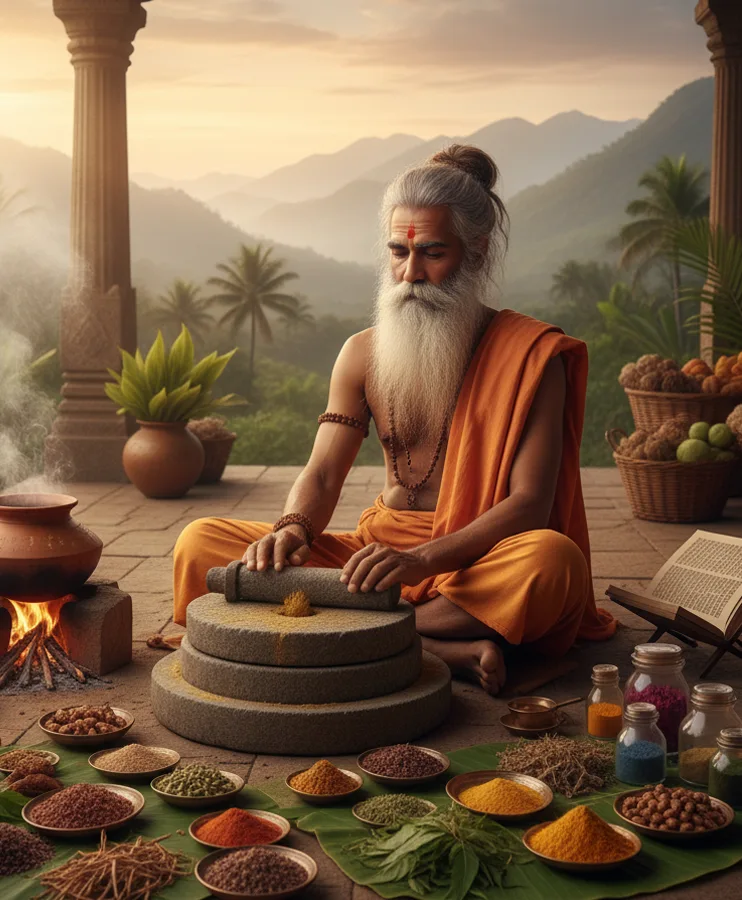
Origin of Ayurveda
Vedas are the most ancient literary work known. Vedas are Collections of mantras. It reflects the living habits of ancient people, their thought, customs, problems they encountered and remedies for that, their ambitions, ideas, achievements, and pitfalls. Vedas also contain the methods and measures, adopted for health care and treatments.
According to Hindu Mythology, the Universe was created by Brahma. He created Vedas by capturing knowledge from the four directions. The Vedas contain knowledge about the Universe. Hence it contains knowledge about life too. So, Brahma is regarded as the Adya (first) Guru of Ayurveda.
Ayurveda subjects are dealt not only in Vedas, but also in Aranyakas, Brahmanas, and Upanishads also. Garbhopanisad mentions about doshas, dhatu, and growth of fetus. But all these details are not presented in a structured manner, but are scattered all over the Texts. A structured presentation or making a treatise on Ayurveda had taken place only between 2nd century B.C. and 10th century A.D. The most popular and authentic Samhitas, which are still in use, are Charaka Samhita and Susrutha Samhita. Charaka Samhita deals mostly with the General Medicine (Kaya Chikitsa),and Susrutha samhita deals mostly about the Surgery(Salya Tantrum). From the style of presentation and language it is deducted that Charaka Samhita is older than Susrutha Samhita. Another treatise on Ayurveda was written only after a long period of time. It is called Ashtangasangraha by Vagbhata. Ashtangasangraha contains all the knowledge available in Charaka and Susrutha samhitas, and the knowledge acquired after that. Ashtangasangraha is an elaborate work. Hence Vagbhata himself wrote another treatise which contains the essence of Ashtangasangraha, called Ashtangahrudayam. (There is another school of thought who believe that these two texts are written by two Vaghbhatas.)